
Today I want to share what you should be looking for in a birth class that will prepare you for a “natural” hospital birth. I say “natural” because that seems to be mean something different for everyone. In this article we’ll discuss what natural can mean, and how to best prepare for that (no matter what it means) prior to birth.
Before we get started — why take this from me? Hello, I’m Hilary, the curly head here at Pulling Curls®. I’m also the curly head behind the website The Pregnancy Nurse®. I’ve been a nurse since 1997 and I have 20 years of labor and delivery experience.
During that time, I’ve seen thousands of moms labor, in many different ways, but I’ve seen what preparation actually prepared them to get a positive birth experience. I’ve also had 3 kids of my own, and know how your hopes and dreams can be really different than what the hospital offers.
I’m super glad you’re here, because this is a really important topic.

What is “Natural” Hospital Birth
This is tricky because we’re clearly not going to be giving birth in a wooded forrest floor, and not even in our own home in our own bed.
If you’re here, you’re likely planning on a hospital birth — which unfortunately doesn’t always look particularly “natural”. That makes me sad. I do know that the hospital hurts a few of our natural insticts, which I don’t love.
Personally, I do believe that it is the safest way to give birth, but I do believe that there are ways to get it to look more like what you’re hoping for.
However, in my 20 years of experience, it’s much beyond breathing and not getting an epidural. There’s more to it — so lets talk about.
Why a Natural Birth?
Honestly, this is up to you. Hopefully you’ve considered a birth plan (grab my free series here):

And in that, you’ve decided what “natural” means to you. Most often I hear it meaning:
- No induction – you go into labor on your own.
- No epidural – you rely on other methods
- No medical pain management – only natural methods
But honestly, everyone has their own ideas about what a “natural” birth will look like. Some mean delivering in a tub, or with zero interference from the hospital staff. There’s a whole spectrum of “natural” (which is why it’s important to use a birth plan to share what you want for your birth!).
Whatever type of birth you’re hoping for, doing a birth plan and discussing it with your doctor or midwife ASAP is smart. Some of the things (for instance, a tub birth) can’t be accommodated by all facilities. So, that’s good to know (and possibly change expectations or facilities).
I once saw a birth educator say you could “tell” your hospital you are bringing in a portable tub but I’m here to say that might not be the case. The hospital may not be able to take the load of the extra water on their floors, not to mention the risk of flooding. Be really mindful about who you’re listening to and if their recommendations are truly realistic. A LOT of people online give unrealistic expectations to get attention (and followers) on social media, but that’s not helping you out long-term.
So, my question for you — why do you want a natural birth, what does it mean to you? What are you hoping for? Tell us down in the comments! I think we could have a good conversation there!
Best Class for a Natural Birth
I agree that preparation is the key to a “natural” hospital birth — no matter what that means to you.
I also agree that the hospital doesn’t do a lot of “natural” things. I mean, that’s one of the best things about it. Natural doesn’t always mean safest. That’s probably why you have chosen a hospital birth team.
Cliff Notes: I recommend this class << I think it’s the best to truly prepare you.
So, what should a birth class include to help you have a natural hospital birth? Let’s talk about it….
Practice Natural Pain Management Techniques
It’s true, you want to learn some natural pain management techniques. It should include:
- Breathing — it is a powerful tool to help your body relax to help your baby descend into your birth canal
- Positioning — movement is a very powerful tool in birth (no matter “how” you hope to birth — even if you have an epidural)
- Other pain management techniques including heat, massage, etc
I really do think these are important, but I think a lot of people have boiled birth class down to just this.
Honestly, I think providers loved that this was the only way people prepared to have their baby. It made their job of “telling” you what to do about the rest of the birth easy on them.
Pain management is important, but is just one of the keys to getting a natural hospital birth (and honestly, probably the easiest one to teach).
Basic Physiology of Birth
I do see a lot of “natural” classes who focus a lot on this. But honestly, what you need to know can be taught very quickly.
I actually share one of the best tips about this in this post on birth stages:

While this can help to know what to expect, you should also be surrounded by experts who can tell you where you are on this path. And, the bad news is that our bodies don’t always listen to the “physiology” or go according to plan.
And then we have to….
Learn about Possible Hospital Interventions
This is where a lot of “natural” birth classes simply tell you to say no to these, “unless it’s an emergency.”
But, I think that you and I can go both agree that we’d prefer not to let things get to an emergency before we’re dealing with them.
If you see a leak in your shower, are you going to wait until it looks like it’s going to collapse into the floor beneath it at your house before you even call a plumber? Probably not….
Same goes for the hospital.
It’s important to learn about what the hospital might offer, what it looks like and how it can be used to help your birth be safer (because yes, these things do truly make things safer).
Things like:
- Breaking your bag of waters
- Using the IV
- An epidural to help labor progress (shocking that a “natural” class should also share how an epidural can help — but it’s true!)
- Inductions (there are SO many inductions lately, and it’s not just because people are “lazy” — I’ll have more of that in the next section)
- Cesarean birth (yup, you should know something about that too).
I think a lot of birth classes tend to take the idea that if you don’t think about it, it won’t happen.
And that head in the sand approach, my friend, causes birth trauma. It doesn’t lead to better birth outcomes. In fact, taking classes that inform you of these less aesthetically pleasing parts of birth really do improve outcomes. I talk about the studies in here.
🚩🚩🚩 Don’t get me started on classes that say “get your perfect birth” because no one can sell you that, but it sure gets clicks on Facebook ads. It’s a real red flag for me.
Honestly, I think they ignore a lot of this because most birth classes are taught by people who don’t know much about these things. They took have their head in the sand about it, so they don’t teach it.
Which is why I recommend a birth class taught by a labor nurse. I recommend this one.
At the VERY least they should be very clear to you that these interventions are sometimes very necessary and how to make choices about them…. and we’re going to get more to that. Stay tuned. 🙂
I was just thinking about cesarean rates and I gotta say that even my favorite providers who are very patient and allow patients to make their best choice still have a cesarean rate of 15-20%. That’s still 1/5 — something to think about.
Learn About 3rd Trimester Testing
Honestly, I think this is where a lot of birth goes off the rails for people.
Example:
At 37 weeks, baby is measuring small. You do an ultrasound to find out that baby isn’t getting what they need from the umbilical cord, and they recommend you be induced.
You had no plans for induction, you don’t want one but you slowly realize that mother nature hasn’t made this pregnancy perfection, and this may help baby have a better outcome if you’re induced.
I see this happen a million different ways:
- Preeclampisa
- High blood pressure
- Cholestasis
- Baby too big or too small
- Too much or too little amniotic fluid
I actually talk about these very real-life scenarios a bit in my insider tips class:

This is why prenatal appointments are so important. However, when your provider sees something off at those appointments they tend to send you for testing. Most often:
- Preeclampsia labs
- NST (non-stress test)
- BPP (biophysical profile)
And people go into those tests blind, and aren’t sure what will happen or what the results will mean.
And, when the recommendation to induce early comes back, they’re just not sure what to do because they never had this on their radar the whole time.
You may feel like this scenario is rare, but it happens in a good percentage of births anymore. People are older, more stressed out and have pre-existing conditions they didn’t have before. I’d guess in many hospitals the majority of patients giving birth lived-out a similar scenario.
Honestly, I feel so fierce about this part I have a free class that goes over it. I don’t talk about it much but you can join right here. It goes over testing, and anything else that should send you into the hospital in the 3rd trimester.
Most birth classes don’t really start til’ you’re in labor, but that puts you behind before you’ve even started. Good birth class teachers know this. I go over more about what you need to know in this post.
Learn How to Make Choices
And here is where we get to the meat of this issue.
Birth isn’t perfect. Our bodies aren’t always “made” to do this and we often have to pivot and adjust our plans to keep things as safe as possible.
A lot of times we don’t. And that’s awesome, but there’s a decent chance you will have to adjust some parts of your birth hopes to account for safety.
Honestly, that’s part of why hospital births are safer (and frankly, why a lot of home birth midwives send a lot of their patients into the hospital).
You have to learn to:
- Take the information your provider gives you
- Understand the option they’re recommending (and ask questions)
- Make the best choice for you given the information.
For too long providers “told” you that you’re getting induced, but I’m here to remind you that every choice is yours, there is a lot of grey area in pregnancy & birth, and that you can both combine what you want with what your provider is telling you.
I actually have a whole induction checklist to help you get a full picture of what you expect if your provider is recommending that (I wish they were better about doing it, but smart peeps grab this):

A good birth class will help you know options, and how to make those choices.
It’s not going to put their head in the sand that these things “rarely” happen, because they frankly (especially in 2026) do not. These are happening frequently, and often for very good reasons.
I have a video on making choices (and I do think it’s the #1 skill you need):
Appropriate Expectations
Finally a good birth class should give you appropriate expectations for hospital birth.
I agree that you don’t have to follow “policy” — but like I mentioned above, telling someone they can bring their own birth tub to any hospital just isn’t helpful to most people (or, frankly safe for all the other patients in the hospital).
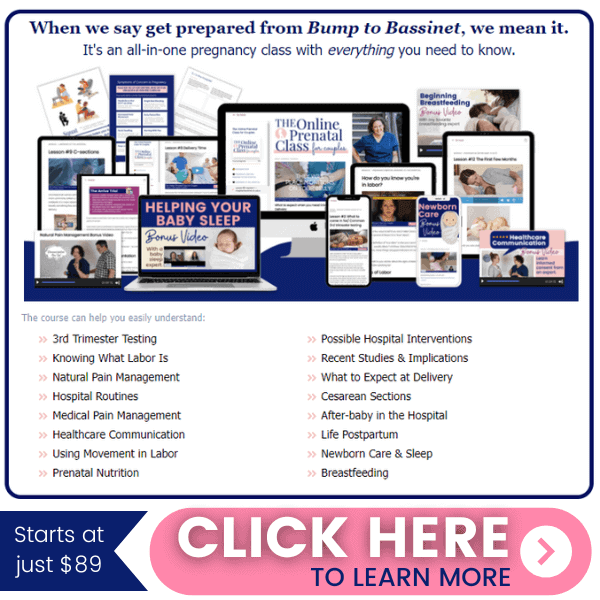
I think this is especially true postpartum (a big part of why I recommend this one).
Personally, I wasn’t prepared at all for postpartum and it made it all pretty miserable. I don’t want that for you. My birth class just acted like baby would come out and everything would come easy after that, and that’s just not true:

So, as you can see a good “natural” birth class includes a lot of things many people don’t talk about.
Anything you learned in this article you hadn’t thought of? Tell me in the comments.
And finally, I am glad you’re even considering a class. Far too many people don’t.. Good preparation makes for good births — and I think you’re on the road to that!
A few notes on a birth class:
- Because most providers are using advertising to sell their birth class the pricing tends to be far too high (advertising adds about $100 to any birth class) — which is why I recommend this one (word of mouth is plenty for that one)
- Be sure to check the credentials of your teacher. It’s important they have helped at a LOT of births.
- Check out if they have any free options where you can see them teach (including Youtube videos) to see if you’re a good fit. Not every teacher is for every student.
Check out this one (you can find some freebies here too) and see if it’s right for you!
Want more information on birth classes check out these posts:
- Why Most Birth Classes Fall Short: Preparing for the Unexpected in Labor
- 14 Best Online Childbirth Classes for Couples
- Free Birth Class with Insurance
- When to Take a Childbirth or Breastfeeding Class?
- Pregnancy & Baby Preparation Classes I Recommend




Leave a Reply